























“We want to know them, to understand them and to know how to make it easier for them if they will consider making aliyah,” a participant told JNS.
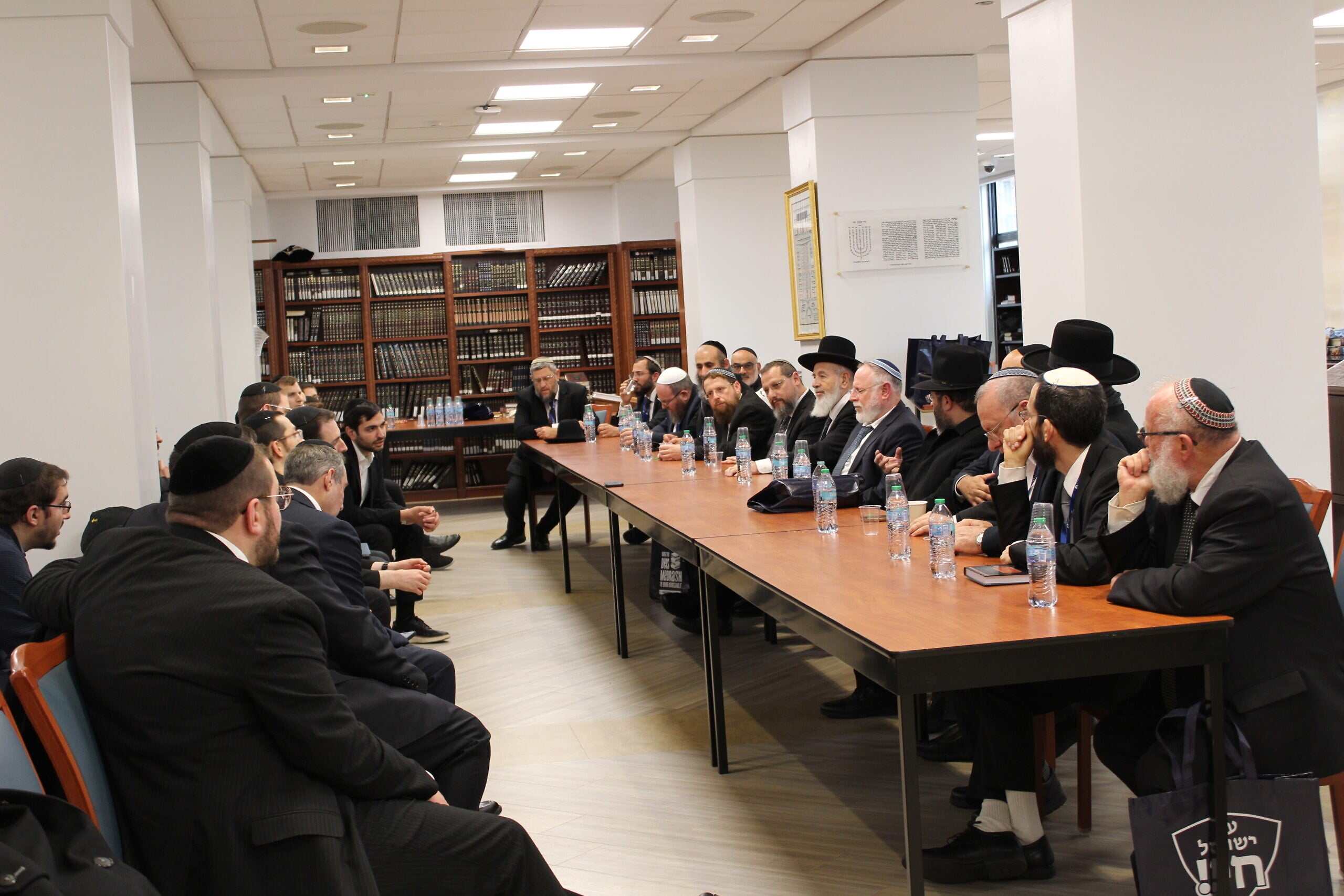
Last month, 17 Israeli rabbis visited the United States, some for the first time, for a weeklong Orthodox Union program designed to teach them more about American Jews and to help them better understand some of the barriers to the latter making aliyah and moving to the Jewish state.
“They live in their bubble. We live in our bubble,” Rabbi Yaakov Glasser, managing director of community engagement at the OU, told JNS. “It was a very beautiful thing to mix them together.”
The program, which is the vision of the late OU leader and rabbi Moshe Hauer, involved a partnership with the religious Zionist group Rabbanei Haaretz Hatova and Gesher, an Israeli organization that promotes Jewish unity.
Glasser, who planned the program with Hauer and is now running it, told JNS that the late OU leader felt “very strongly” that one fosters productive connections when people meet face-to-face rather than at the institutional level.
“The more the different segments of the community interact with each other, talk with each other and meet each other, the better it is for the unity of the Jewish people,” Glasser said.
It was not easy to convince all of the Israeli rabbis to join the program, which ran from Nov. 16 to 23.
Rabbi Chayim Markowitz, who leads the kosher department at Gush Etzion and holds a pulpit in Ma’ale Adumim, told JNS that some of the rabbis told him that others should make the trek. He told them that there is a current pressing need to forgo the rabbinic value placed on remaining in Israel. “I convinced them that we are in a special time,” he told JNS.
‘In Israel, it’s a little bit different’
Rabbi Yoni Don-Yichiya, rabbi of Moshav HaZor’im and a teacher at the _hesder_ yeshiva in Tefahot, talked to JNS while he and the other rabbis traveled from Baltimore to New York on a Thursday night.
“We have brothers and sisters, lots of them, in the United States. Millions,” he said. “The only way to tighten the connection between us and them is from seeing and hearing and talking to them, because we want to know them, to understand them and to know how to make it easier for them if they will consider making aliyah.”
Over the course of the trip, Don-Yichiya learned that it’s not so simple for Americans to move to Israel.
“The meaning of community here is very significant,” he said of the United States. “The rabbi, his whole day is for the community, and in Israel it’s a little bit different.” In Israel, pulpit rabbis tend to hold other jobs that preclude the kind of individualized attention that American rabbis, who are full-time, can afford congregants.
Students with whom the rabbi met at Yeshiva University also told him that they aspired to make aliyah but wanted to keep their family Jewish traditions. “They are afraid that maybe they won’t find in Israel the community that would be good for them,” he said.
“I think that we, the rabbis in Israel, need to learn from this trip how to make it better and easier for Jewish people here to make aliyah if they want,” he told JNS.
Glasser, of the OU, and rabbi of Young Israel of Passaic-Clifton and former dean of Yeshiva University’s Center for the Jewish Future, told JNS that participants “developed an appreciation to the fact that the American Jewish community is very developed.”
“Now, does that mean they still think that even with all this development, we should pack up and move to Israel? They probably do,” he told JNS. “I think they’re starting to realize that if you want to have a relationship with this part of the Jewish people, it can’t only transactionally be rooted in your goal to persuade them to move to Israel.”
Rabbis both stateside and in Israel need to “create connections across what we’re all working on beyond just moving to Israel,” he said.
“Aliyah remains a fundamental value in the ideology of the Modern Orthodox American Jewish Community,’ Glasser told JNS. “At the same time, in order to unify the American Jewish community with that in Israel, we need to build on other aspects of our shared communal experience as well.”
‘We need to first know them’
The delegation didn’t make it to the Columbia University campus in person, but Don-Yichiya was surprised by what he heard from a group of Columbia students. He told JNS that he figured it would be hard to remain a religious Jew at a secular school. “I thought it was very tough and striking to be in Columbia University because of all the propaganda,” he said.
The students showed themselves to be “proud of their Judaism,” he said. “They told us that some of the students, because of the war, started to go on the campus with a kippa, and the girls with Magen David necklaces, and it was exciting for me.”
Markowitz, the Ma’ale Adumim rabbi, told JNS that in recent years, religious Zionist rabbinic leaders in Israel have increasingly recognized the importance of connecting with Jewry worldwide.
“After the war started, we were aware that the war also had a big influence all over the world,” he said. “We saw all the demonstrations.”
He spoke to Rabbi Yaakov Shapira, who leads Mercaz HaRav in Jerusalem, which has some 600 students and scholars and is one of Israel’s largest yeshivas, about organizing international missions to world Jewry.
“I told them that if we want to think about our brothers that are all over the world, we need to first know them,” Markowitz told JNS.
On the trip, the delegation visited Lakewood, N.J., to tour the facilities of Jewish social services groups and Beth Medrash Govoha, a yeshiva with some 9,000 students, and to meet with a deputy mayor.
It also attended the annual Chabad gathering in Brooklyn, which drew about 6,500 Chabad emissaries, met rabbinic leaders at the Lakewood yeshiva, Yeshiva University in Manhattan and Ner Israel Rabbinical College in Baltimore, visited the Chassidic rebbe of New Square, N.Y., and went to the 9/11 Memorial.
Meetings at the Orthodox Union “exposed them to the range of infrastructure and highly developed institutions that exist throughout the American Jewish community, providing high levels of education, Torah engagement and a vibrant communal life,” Glasser told JNS.
Though the Israeli rabbis were impressed with the level of Talmud study at the yeshivas, they were surprised to find that the American seminaries didn’t teach the writings of Rabbi Abraham Isaac Kook, the central religious Zionist thinker and first Ashkenazi rabbi of British mandate Palestine.
Markowitz told JNS that students at Yeshiva University can learn about Rav Kook and his writings, “but it’s not the main approach you have in YU.” The rabbi whose teachings are central to a Yeshiva education is Rabbi Joseph B. Soloveitchik, known as “the Rav” and seen widely as one of the founders of the Modern Orthodox movement, according to Markowitz.
“In this time, we also need the Torah of Rav Kook,” he told JNS.
Rabbi Yitzchak Neriya, who leads the Torah B’Tzion yeshiva in Efrat, also took part in the trip, during which he found that when Rav Kook was taught in American yeshivas, it tended to focus on his views about Israel rather than his philosophy, including his views on secular studies.
“That approach is mostly Rav Soleveitchik’s approach, which is very respectable,” he told JNS. “But there are slightly different things that are interesting, and I think it helps my life and might be good for others as well.”
Glasser, of the OU, told JNS that one of the “main follow-up points” that the Israeli rabbis want to accomplish is to bring more of Rav Kook’s teachings to American Jews. He added that one participant, Rabbi Baruch Menachem Vider, who leads Yeshivat Hakotel, is already setting up study partnerships on Rav Kook’s writings between Israeli and U.S. students.
But that is a challenging enterprise given how difficult the language is in Rav Kook’s writings, which aren’t translated well into English, according to Glasser. He told JNS that the group visited the headquarters of Artscroll, which underwent a “painstaking process” to translate the Jerusalem Talmud, which has very difficult language and was a “heretofore closed work to the English-speaking public.”
A group of scholars with relevant expertise could do the same with Rav Kook’s writings, which would be an “immeasurable contribution” to American Jews and to the connections the program was trying to build, Glasser said.
The group travelled to Baltimore to see Ner Yisroel, and then to Washington D.C., to meet with Ambassador Yechiel Leiter in the Israeli embassy and with Dan Shapiro and Elliott Abrams, a former White House foreign policy adviser, at AIPAC. The rabbis also visited the Washington Monument.
They visited with members of the Syrian Jewish community and went to the Lubavitcher Rebbe’s ohel, and spent time at Young Israel of Woodmere and DRS high school for boys, both Modern Orthodox institutions in Woodmere, N.Y., and spent a Shabbat in Teaneck, N.J.
The Shabbat was an “immersive weekend in a community that very much resonates with their values and focus in the world of Torah,” according to Glasser, whose synagogue the group also visited.
“After spending an entire week together having such a diverse range of experiences and bonding as a group, it was particularly heartwarming to welcome them into our _beit ha’kenneset_,” synagogue, “and share with them how so many of the different values and experience we were exposed to are manifest in our community,” he said.
‘Consumerism’
The Israeli rabbis also visited American Dream Mall, one of the largest U.S. malls, near Teaneck, on Friday afternoon. “We have malls in Israel, even big malls. Not big like American Dream,” Markowitz told JNS. “It gave the rabbis some experience of shopping in America. It’s important.”
It wasn’t just about the rabbis buying souvenirs for relatives back home. “We want to give them this experience, so that they’ll understand some of the aspects of the culture of the American people,” he said.
Glasser said the American Dream Mall says a lot about American “consumerism” and U.S. Jewry, since the country’s second-largest mall is owned by Orthodox Jews and has a kosher restaurant. “That is part of our reality,” he said.
Neriya, who leads the Efrat yeshiva,laughed when he told JNS that he went into one store and “bought everything that I saw _shayech_,” or “relevant.”
“That’s it,” he said. “I hate shopping, OK?”
‘We’re not terrified’
Neriya told JNS that it became clear on the trip that there were large gaps between U.S. and Israeli perspectives, including when it comes to New York City mayor-elect Zohran Mamdani, who has said that he would have the Israeli prime minister arrested.
“The way we feel what happened with Mamdani is one thing. The way Jews that live in America feel is totally different,” the rabbi said. “In Israel, people are terrified. But people here say, ‘No. We’re not terrified. He was chosen because of what he offers for the cost of life. Yes, he’s an antisemite, but we have had so many antisemites before.’”
Like Don-Yichiya, he often heard on the trip that Americans worry about connecting with rabbis in Israel to the same extent that they do stateside if they make aliyah.
“Here the rabbi knows you from your bris to your bar mitzvah to your wedding, then your kid’s bris,” he said of America. “He’s very involved in your life.”
In Israel, “he’s in a shul, if you want to come, ask him, but he will not definitely run and approach, always accessible.”
“What they pay him is so little that he has to work in one or two other jobs,” Neriya told JNS. “As opposed to America, someone that works in his position, that’s his position. That’s it.”
Neriya was surprised to learn in Washington how closely U.S. officials follow news in Israel. He took away from that that “we have to be careful, very careful, and really understand that a kid moving a stone in Judea and Samaria might cause the craziest thing in the White House.”
“It was very interesting to hear in terms of how news like this reaches the president,” he told JNS. “When something happens there—violence, or politicians who, unfortunately, don’t speak politically correct—how much damage can happen on the same spot in the White House.”
“The president doesn’t have time,” he said. “He won’t spend two hours to see what happened.”
It pained Neriya to hear Haredi rabbis in the United States say that young observant Jews lose their identities if they join the Israeli military.
“They were sure that almost everybody who goes to the army stopped being religious,” he told JNS. “So many of our students went to the army, went back, no damage, nothing, perfect.”
He figures that the meetings on the trip were important both to show that Israeli and American rabbis are partners and to demonstrate that the way to solve inter-Jewish disputes, which can get ugly, “is by knowing one another.”
Glasser told JNS that he doesn’t think that the trip changed the Israeli rabbis’ minds about whether American Jews ought to make aliyah. He thinks that many came away with an understanding that American Jewry “is not some precarious community about to walk off a cliff,” but instead “highly entrenched, highly developed, massive infrastructure of a huge community, with gigantic yeshivas and developed organizations.”
For some of the rabbis, their main interaction with Americans comes when the latter visit Israel on holidays. “I don’t think they had any clue what the breadth of the Jewish community is about,” he said.