














Two Jews meet. One pulls his Soviet passport from his inside pocket:
“Today I changed my nationality on my passport. What did it say before, in the fifth section? ‘Jewish.’ And now? Now it’s written in black and white: ‘Russian.’ Do you understand? The end of my suffering for being Jewish.”
“Oh, you fool!” laughed the second one. “They don’t punch your passport! They punch you right in the face, in your Jewish face!”
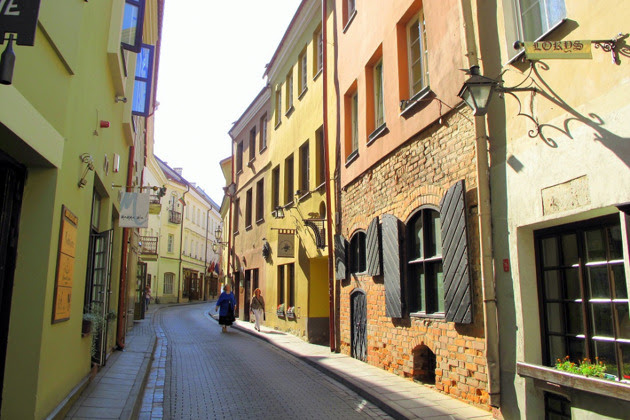
I had never run so fast. I was an average runner, neither one of the best nor the worst, at our Polish primary school, where I was in the third grade. But now I was running so fast, as if a rabid dog or even a leopard were chasing me. I flew through the narrow alleyways of Vilnius’s Old Town and didn’t look at what was happening behind me. Every now and then I turned down another alley, changing direction, trying to lose myself in Vilnius’s winding streets. When I emerged back onto Gediminas Avenue, I slowed down a bit and walked at a brisk pace so people wouldn’t think I was running away. Only once did I glance over to see what was happening behind me and where my pursuers were. They were still far away, and it seemed to me they were running, but slowly.
For them, of course, it was harder to run than for me. Dressed in long soldier’s greatcoats, wearing heavy leather boots, and with rifles slung over their shoulders. Who can run like that? And the civilian, a tall, thin man with long feet, was walking alongside them, at their pace. Seeing them, I started running again. Where did I get so much strength? I don’t know. A few minutes later, I had vanished from their greedy eyes. I ran towards Tauras Mountain, circled around it, turned right, and arrived at my alley, Pakalnės Gatvė. I reached our house, crossed the large courtyard, and hid in the shed. Do you know what a shed is? It’s a small wooden structure where firewood and charcoal for the ovens, bicycles, skis, gardening tools, and even sacks of potatoes were stored. There, in my “kingdom,” I felt much safer.
I had never run so fast. I was an average runner, neither one of the best nor the worst, at our Polish primary school, where I was in third grade. But now I ran so fast, as if a rabid dog or even a leopard were chasing me. I flew through the narrow streets of Vilnius’s Old Town and didn’t look at what was happening behind me. Every now and then I turned down another alley, changing direction, trying to lose myself in Vilnius’s winding streets. When I came back out onto Gediminas Avenue, I slowed down a bit and walked briskly so people wouldn’t think I was running away. Only once did I glance over to see what was happening behind me and where my pursuers were. They were still far away, and it seemed to me they were running, but slowly.
First, I caught my breath after such a sprint, regaining my composure. This lasted perhaps fifteen or twenty minutes, or maybe an hour. I don’t remember exactly how long, but it doesn’t matter. When I had calmed down, I went inside as if nothing had happened. But is a mother, after all? She immediately sensed that something was wrong with me. Her face went pale. Surely she sensed something, and perhaps my appearance frightened her? I didn’t look in the mirror, but I felt agitated and sweaty. I wiped the beads of sweat from my brow with a dish towel and reassured her, telling her that I was fine, that I’d simply been playing soccer with the Polish boys at school.
So what if I told a lie? I didn’t want to worry her. One of my Jewish friends told me that sometimes you can tell a lie, as long as you don’t worry your parents. I agree with him. That was the end of it. Until my mother’s last day, she knew nothing about that incident. And not only her. I didn’t tell anyone myself. No one! Not even my children and grandchildren knew. You are, it seems, the first people to whom I’m telling the whole story.
It happened in the summer of 1941. The Germans had already occupied Vilnius, rounded up all the Jews (including some of my best friends), and locked them up in the old town, in the “ghetto,” as they called it. From our neighborhood, the ghetto was a bit far. When I found out, I was terrified and asked my father, “Where have my Jewish friends disappeared to?” But he didn’t answer. Perhaps he didn’t know, and perhaps he simply didn’t want to tell me the truth. But the very next morning, before leaving for work, he sat me down across from him on a low bench and asked me to listen to him until the end. My father, Adolf Imanuilovich, as everyone called him, was dressed in his work clothes: a crisp black uniform with gleaming copper buttons, polished black shoes, and a cap with a black peak. Just as befits a mail coach supervisor at the Vilnius train station.
He took a cigarette from a silver case, lit it with his gold lighter, a birthday gift from my mother, and addressed me with this speech:
“Listen to me, Romuald,” he called me suddenly by my official name, not “Roma,” as he always did.
To me, it was a sign that he was about to tell me something important, some momentous news. He looked me in the eye and spoke slowly and clearly:
“Listen to me, my son. What happened to your friends, I don’t know. I’ve heard that all the Jews are being taken away from here. Where to? I don’t know. And don’t ask me why, because I myself have no idea.”
I wasn’t sure he was telling me the whole truth. I felt he knew more, but I didn’t have the courage to ask. In our house, it was customary that when the father spoke, everyone remained silent, and what the father commanded was done.
“But you can rest assured, my son,” he reassured me, “the Germans won’t bother you. Not you, not your sister, not our family. Why am I so sure?” He inhaled from his cigarette and exhaled a puff of white smoke through his large, crooked “Jewish” nose. “Because… uh… because we aren’t Jews. We belong to the Karaites! And the Germans only take Jews, Roma, and communists.”
He paused thoughtfully for a moment and inhaled again. “Aren’t we Jews?” I wanted to ask him about the Jewish hospital on Hospitalna Street, where I was born, but my father seemed to read my thoughts:
“Just because you, my son, were born in a Jewish hospital doesn’t mean you’re Jewish. Your mother chose the Jewish hospital because it had the best doctors in all of Lithuania. You know we belong to the Karaite people. We’re a small people, but we have no connection whatsoever with the Jews. How am I so sure? I heard it myself from our honorable cantor.” He gave a sermon at the synagogue and told us that in Berlin it had been decided that the Karaites were not Jewish. The Germans investigated, and it seems the Karaites are descended from the Turks. Why Turks? I really don’t know, and I don’t care. And tell me, my dear, what language do we speak among ourselves? Polish, of course. Do we speak Yiddish? Of course not. Where would we know Yiddish? Now you see that we are not Jewish. And if that’s the case, no one will harm us. Not even the Germans and their Lithuanian helpers. No one!
As I’ve already explained, the Karaites have great respect for their fathers. For us, there is no doubt that what comes out of their mouths is the absolute truth. After my father’s words, I felt free and at ease to wander and roam all over the city. In the summer there were no classes at school, so I had all the free time I wanted. But then everything turned upside down, and I almost paid with my life for being so sure I could do whatever I wanted. And now I know that the story, whose ending I’ve told you, could have ended horribly.
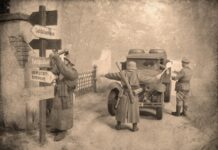
One beautiful summer day, right after the breakfast my mother, Yevgenia Semionovna, had prepared for me, I went out into the city, as was my custom, and headed for the river. And not the great Viliya River, either. There was nothing to do there. I went to the small Vilnialė stream. I liked to sit on the bank of the Vilnialė and throw pebbles into it. The stream wasn’t deep; swimming in it was impossible. What else could I do? Pick up small, flat pebbles and toss them into the water so they would skip across the surface to the other side. On my way to the stream, I passed through the wide Cathedral Square. As I was almost out onto the Bernardine Garden, where the stream flowed, I suddenly heard a loud German shout from afar: “Jude!” I turned to see who was shouting and saw a German military patrol heading toward me. There were two German soldiers and a young civilian with them. They saw me, started walking faster and faster, and the civilian, with one hand outstretched, shouted: “Jude! Jude!” He was wearing a long black raincoat with a white stripe on the left sleeve. In Vilna, they were called “Belopovyazóchnikės.” I had heard from my friends that they helped the Germans, and were even worse than them. But the one with the white stripe seemed even stranger than the others. His face was completely black! He was a black man, a black man! What kind of black man? Even before the war, we children had heard that in Vilna, in Zarechye, there lived someone as black as coal—a black man. He had married a Lithuanian woman and lived here in the city. I had never seen him before. But now I didn’t have time to think about the Black man. It was precisely him, the civilian, who began to run faster and faster with one hand outstretched, shouting like a madman, “Jude! Jude!” And the Germans ran with him.
Then, as they say, I grabbed my feet and started running as fast as I could. I ran, and thoughts raced through my head. Had my father assured me that the Germans wouldn’t bother the Karaites? Then why were they chasing me? I certainly have black hair.
Big and curly, but that doesn’t mean I’m Jewish! And maybe I look Jewish? Of course not! My eyes are gray, and I don’t have a big Jewish nose either! And the black guy? What kind of “friend” is he to the Germans? His wife is Lithuanian, yes, but him? Didn’t he come from America? There are lots of black people in America. I read about them in Uncle Tom’s novel. I read that book maybe three times, I liked it so much. We children had searched all over Zarechye to see what a black person looked like, but we didn’t find one. But now, when he’s so close to me, I don’t want to see him! I’ll run away! No matter how much he chases me, he won’t catch me. I didn’t even want to imagine what would happen if he did catch me. So I started running faster and faster, until I reached my alley and my house. We lived in the last two-story building on Pakalnės Alley, or as we called it in Polish, Podgúrnaya.
From that very day until the end of the war, I behaved more cautiously. I didn’t wander the streets, I only played with children in our neighborhood, not far from home. I didn’t go to school alone. My mother or father always accompanied me, just so I wouldn’t be alone. For four long years, the city was a stranger to me.
No one knew what had happened to me. I didn’t tell anyone, not even my older sister Galina, although I had always confided all my secrets in her. Everything I experienced that day remained my deepest secret. After the war, new neighbors moved in next door, and they were Jewish. Over time, our families became the best of friends, and even more than that. We felt like one big family. I’m still in touch with their son, Elinke, who emigrated to Israel in the 1970s. Incidentally, many of my relatives and friends, Karaites like me, live in Israel, but I’ve never been there. Elinke did visit Vilnius several times, and on one of his last visits I told him the story, which he describes here on my behalf. I never saw the Black man again. I only heard that the Russians had arrested him, accusing him of aiding the German Nazis, and had sent him to Siberia. He deserved it, of course!
Today I know that the Karaites are part of the Jewish people, part of two thousand years of Jewish history.