


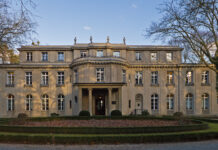
















Many people believe the Wannsee Conference is when the Germans decided on the “Final Solution.” That is a misconception. The meeting—held on January 20, 1942, at 56–58 Am Großen Wannsee, a villa in a Berlin suburb—was not where the decision to murder Europe’s Jews was made. It was a coordination meeting: a bureaucratic effort to align ministries and agencies around a policy to annihilate the Jews that was already underway.
SS General Reinhard Heydrich, chief of the Reich Main Security Office (RSHA), convened the gathering not to discuss a new strategy for the “Jewish Question,” historian Richard Breitman argues, but to organize responsibilities and secure interagency cooperation. The meeting lasted roughly one hour to ninety minutes. The officials did not debate whether to proceed; they discussed how to proceed—and how each agency would support the process.
Historian Yehuda Bauer suggests it was barely a “conference” at all. The participants were not top party celebrities; they were senior bureaucrats—interagency officials who could make the machinery of the German state function.”
Mass murder was already in motion
By the time officials assembled at Wannsee, the systematic murder of the Jews had already begun in the East. Following Germany’s invasion of the Soviet Union on June 22, 1941, Heydrich deployed approximately 3,000 men of the Einsatzgruppen (mobile killing units) behind the advancing Wehrmacht, the German army. Their mission was to locate and murder Jews across vast territories, including areas of the Baltic states, Eastern Poland, and other regions under German occupation. German historian Heinz Höhne notes that a large percentage of Jews in the Soviet Union were concentrated in cities—making them more traceable once the Germans had control.
Why bureaucracy mattered: trains, money, and property
Mass murder on a continental scale required modern logistics. Seizing and forcibly transporting millions of Jews required cooperation from technocrats, planners, and administrators—especially the German rail system, the Deutsche Reichsbahn. Political scientist Raul Hilberg stresses that European Jews could not have been deported and destroyed without the Reichsbahn. The railways worked with the military, police, industry, and the SS to move Jews to ghettos, forced-labor sites, and extermination centers. Victims were scheduled, ticketed, and transported through a system designed for efficiency—people “booked as passengers” but treated as cargo.
Bureaucratic support was also required to manage the financial side of the operation: confiscation of property, disposal of possessions, and the handling of Jewish assets and funds. The sheer scale demanded coordination across agencies, which is one reason Himmler and Heydrich briefed select officials on the mass-murder policy.
When was the decision made to murder European Jewry?
German historian Christian Gerlach argues that Hitler made the decision “in principle to murder all the Jews in Europe, either on or around December 12, 1941…. At least that is when it was made public.”
During a speech on December 12 to approximately 50 regional and “sectional” leaders of the Nazi Party, Joseph Goebbels, Reich Minister of Propaganda, reported: “Regarding the Jewish Question, the Führer has determined to clear the table. He warned the Jews that if they were to cause another world war, it would lead to their own destruction. They were not empty words. Now the world war has come. The destruction of the Jews must be the necessary consequence. We cannot be sentimental about it.”
The key point for readers: by Wannsee, the policy direction was set. The regime’s challenge was operational execution and administrative alignment.
What Wannsee did—and did not—settle
Though the decision to change policy was conveyed to the appropriate authorities, this resolve did not translate quickly into increased mass murder or the construction of new extermination camps. Heydrich later reported satisfaction that the participants had reached “complete agreement” on the “practical enforcement” of the Final Solution. Most telling, Gerlach notes, was what did not happen: no one objected.
The conference also did not resolve every question. For example, no final decision was made at Wannsee (or later) about whether to include so-called “half-Jews” (Mischlinge) under the Nuremberg racial framework. The laws themselves were never formally revised. Gerlach reports that the Propaganda Ministry and other leading officials worried that harsh measures against people in mixed marriages could provoke public backlash from non-Jewish relatives.
Even then, there was not yet a single “program” for annihilation
In December 1941 and at Wannsee, key officials—including Heindrich Himmler, Reichsführer of the SS, Heydrich, and Adolf Eichmann, head of the Jewish section in the Gestapo—did not yet have a single, fully operational blueprint for continent-wide extermination. After Wannsee, Eichmann and his collaborator Friedrich Bosshammer compiled detailed reports on anti-Jewish policies across Europe—covering where Jews lived, when deportations could occur, and where they would be sent.
Gerlach points to high-level discussions that illustrate the absence of a settled “final” logistical plan at that stage, including proposals to deport Jews to Siberia. He notes that Hitler rejected the idea in mid-1942, reportedly asserting that Jews were the “most climate-resilient humans on earth,” and that Siberia would only strengthen them. The comment is grotesque—but it underscores that German leadership still floated different operational concepts while remaining committed to a murderous outcome.
Gerlach adds that as late as early 1941, Heydrich and Himmler assumed Jews might die over time through forced displacement and attrition, rather than be murdered rapidly. Even some officials involved in mass killing sent reports implying the “Jewish Question” had been “solved,” while proposing that remaining Jews be exploited as forced labor—suggesting that, even among perpetrators, the operational end-state and pace were still being formed.
A final note: why Wannsee matters
As Bauer writes, Wannsee “was but a stage in the unfolding process of mass murder.” People often grant it more symbolic weight than its participants did at the time. Yet it remains historically significant for a chilling reason: it reveals how a modern state can coordinate mass murder through routine administration.
The importance, Bauer asserts, “appears to be that given a murderous ruling elite and the identification of large parts of the middle class and intelligentsia with the regime as such—not necessarily with the ideological underpinning of the murder itself—the machine of the state will coalesce to execute total mass murder. The fact that the victims were Jews was not accidental….”
The danger for us today is there is an historical precedent for future Wannsee summits. Hilberg, in turn, alerts us to the need to study bureaucracies so that our descendants will be vigilant. His warning is not only about Nazi Germany; it is about bureaucratic systems as such. Studying Wannsee is, in part, studying how governments can be weaponized—and why vigilance matters.
Dr. Alex Grobman is Senior Resident Scholar at the John C. Danforth Society, a member of the Council of Scholars for Peace in the Middle East, and serves on the advisory board of the National Christian Leadership Conference of Israel (NCLCI). Copyright Alex Grobman, 2026.