




















Moshe Goldsmith of Teaneck, N.J., never imagined that something he did almost absentmindedly during his Masa Israel Journey gap year would one day help save a life.
Six years ago, while participating in the Aardvark Israel program, he attended an educational event where participants were invited to join the bone-marrow registry run by Gift of Life, an organization dedicated to saving lives through marrow and stem-cell transplants.
The process was simple: a quick cheek swab to collect a saliva sample, which would be entered into a global database in case it matched a patient in need.
“I remember when I did the swab, thinking it would never come to anything; I immediately forgot that I even did it,” he told JNS in a recent interview. “I thought I would donate if I was a match, but I really didn’t expect it.”
After completing the one-year program, which allowed him to immerse himself in Israeli society, Goldsmith returned to the United States. But the experience left such a strong impression that he later decided to make aliyah—a choice that would ultimately prove life-changing for both him and someone else.
The call that changed everything
Six years later, Goldsmith received a call that set off one of the most meaningful chains of events in his life. By the time the Gift of Life registry managed to reach him—through his mother, after struggling to track down his new number—he was already living in Jerusalem.
“When I realized I could save someone’s life, it was a moment I’ll never forget,” he said.
He had been identified as a match for a 67-year-old woman battling cancer.
“It wasn’t even a question—I immediately said yes,” he said. “I knew it was the right thing to do, and I would want someone to do the same for me if I were ever in that situation.”
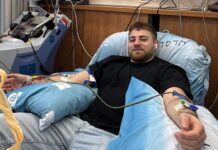
On Jan. 19, 2026, Goldsmith donated stem cells at Hadassah Medical Center in Jerusalem. A month later, he said he felt “100%” and had no symptoms.
He hopes his experience will help dispel misconceptions about the process.
“The day of the donation itself was actually pretty light,” he said. “I had an IV in each arm and sat for about four hours. I walked out of the hospital feeling pretty much back to normal.”
He has no regrets. “I feel that the woman I donated to received the gift of life,” he said. “And I received my own gift—the opportunity to save one.”
Moshe Goldsmith after the bone marrow transplant procedure. January 2026. Credit: Courtesy.
A year that shaped his future
During his Masa program, Goldsmith interned at a Jerusalem food bank that prepares and distributes meals for people in need.
“It was an amazing year,” he said. “I loved my internship so much that I saw it as volunteering rather than work. I enjoyed making food and knowing I was doing something meaningful.”
The experience solidified his decision to move to Israel permanently.
“My gap year cemented my decision to make aliyah,” he said. “After working, volunteering and learning here, I knew it would be my home.”
He arrived in Israel on Oct. 4, 2023. Three days later, the Hamas-led attacks of Oct. 7 upended daily life across the country.
“I had so many plans, but after Oct. 7 everything was turned upside down,” he said. “No one had any sense of routine.”
Friends and family urged him to return to the United States, and a former employer offered him his job back. He declined.
“Not for a single moment did I consider going back,” he said. “It didn’t feel like an option. I had this feeling I could do this.”
Moshe Goldsmith’s Masa internship inspired his career path as head chef in an Israeli restaurant. Credit: Courtesy.
Today, Goldsmith lives in Jerusalem with one of his brothers, who is serving in the Israel Defense Forces. All four of his siblings have made aliyah. He now works as head chef at a Jerusalem restaurant, Mojos.
Looking back, he sees a clear thread connecting his journey—from his Masa year to his immigration to Israel, and ultimately to the moment he helped save a life.
“To me, it feels like reassurance that I’m on the right path and in the right place,” he said. “None of this would have happened if I didn’t have my connection with Israel.”