When we hear the term “Holocaust literature” we often associate it with books about the Holocaust—Elie Wiesel’s Night being a particularly famous example. But “Holocaust literature” can also carry a quite different meaning—that is, literature written during the Holocaust. On February 15, the Yiddish Book Center will present Making and Unmaking Literature in the Warsaw, Lodz, and Vilna Ghettos by Professor Sven-Erik Rose, who will be in conversation with Holocaust studies scholar Hannah Pollin-Galay and David Mazower, the Center’s research bibliographer and editorial director. Rose’s book is the first study devoted to how little-known but essential authors grappled with the destitution of ghetto existence by writing within, at the limits of, and against an array of literary scenarios, tropes, plot lines, and generic conventions, including those of nature lyric, modernist interior monologue, the realist social novel, the detective story, and the gothic horror tale. For more on this essential subject, let’s dive in.
The Day After
|
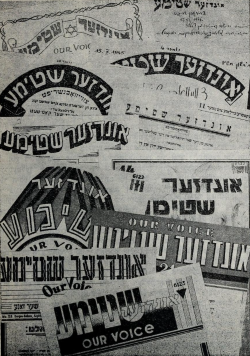
| One can question whether literature written immediately after the Holocaust occupies the same category as literature written during the Holocaust, but it is a fact that a great deal was written by survivors in displaced-persons camps. Not only were books written but reference works were created to try and keep track of them all. This book, published in the Bergen-Belsen DP camp in 1950, provides a bibliography of all Yiddish works published in the British zone of occupation between 1945 and 1950.
Read a bibliography of Yiddish publications in the British zone of occupation |
|